

We successfully cope with tasks of varying complexity, provide long-term guarantees and regularly master new technologies.

+91 9825382130
324 - Orchid plaza, Sama Savli road, B/H MC donald, Gujarat, Vadodara, India - 390024.
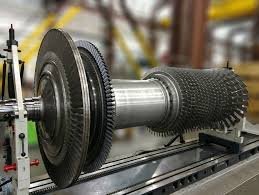
A gas turbine rotor is one of the most critical components in a gas turbine system. It acts as the central rotating shaft that connects various stages of the turbine and compressor, enabling efficient energy conversion from fuel into mechanical power.
The gas turbine rotor is a high-speed rotating assembly consisting of multiple components such as:
Turbine discs
Compressor discs
Blades and spacers
Shaft
It operates under extreme conditions including high temperature, pressure, and rotational speed, making it a highly engineered and precision-critical component.
The rotor plays a vital role in turbine operation:
Converts thermal energy into mechanical energy
Drives the compressor for continuous air supply
Transfers rotational energy to the generator
Maintains system balance and stability
Without a properly functioning rotor, the entire turbine system cannot operate efficiently.
Gas turbine rotors are generally classified into:
1. Welded Rotor
Made by welding multiple discs and shaft sections
Common in heavy-duty turbines
Strong and reliable
2. Bolted Rotor
Assembled using bolts and tie rods
Easier maintenance and replacement
3. Integral Rotor
Manufactured as a single piece
High strength and reduced failure risk
Due to harsh operating conditions, rotors may face several challenges:
Thermal stress and distortion
Rotor imbalance
Blade damage
Fatigue and cracking
Corrosion and erosion
Regular inspection and maintenance are essential to avoid unexpected failures.
Proper maintenance ensures long service life and performance:
Dynamic balancing
Non-destructive testing (NDT)
Crack detection and repair
Blade replacement
Precision machining
Advanced repair techniques can restore the rotor to near-original condition.
In power generation, the gas turbine rotor directly impacts:
Efficiency
Reliability
Output performance
A well-maintained rotor ensures smooth operation and reduces downtime.
The gas turbine rotor is truly the backbone of turbine performance. Its design, maintenance, and precision engineering determine the overall efficiency and reliability of the entire system. Investing in proper inspection and repair services is essential for long-term operational success.